AI-Driven Pentest Tools: Goal-Oriented Design and Coverage Blind Spots

Abstract
This study investigates whether open-source AI-driven penetration testing tools, in which the model autonomously selects each successive action, are architected to provide exhaustive coverage of a defined scope or to perform the goal-directed search characteristic of red-team operations. AI-assisted tools, in which a human operator selects each action, fall outside its scope. Through static, white-box analysis of source code, two tools drawn from a purposive sample of six widely used AI-driven repositories were evaluated against ten metrics. Each tool is goal-directed by construction: the model selects every action, a run terminates once the goal is proven or a resource budget is exhausted, and sampling parameters are left unpinned. Coverage is computed in each case, but the measure is advisory and coarse-grained, and no code path prevents a run from completing while items remain untested. Audit logging is extensive; however, runs cannot be replayed and reports provide no negative assurance. We conclude that such tools are best operated as goal-directed search engines under a human operator who maintains the coverage ledger (n = 2).
1. Introduction
This study examines whether the most widely adopted open-source AI-driven penetration testing tools are architected to deliver exhaustive coverage of a defined scope, or whether they instead implement the goal-directed search characteristic of a red-team operation. The analysis targets AI-driven tools, in which the model itself selects the next action, rather than AI-assisted tools, in which a human operator selects each action and the model merely informs that decision (see Section 2). The investigation rests on source code rather than benchmark results, because source code reveals what a tool is designed to guarantee, not merely what it happened to do in a single execution.
The question is consequential because the evidentiary value of a penetration test report depends on its negative claims, namely that a named area was tested and found free of vulnerabilities. In an AI-assisted tool, the human operator remains the coverage authority. In an AI-driven tool, that authority transfers to the model unless the architecture retains it; the architecture must therefore be scrutinised before the tool is relied upon in enterprise or compliance-driven engagements.
Four research questions guide the study:
- RQ1: Which objective does the architecture implement: exhaustive coverage of a scope, or a single sufficient path to a goal?
- RQ2: Does the code maintain global state recording tested and untested items, and does the engine enforce that state?
- RQ3: Given the answers to RQ1 and RQ2, what role must the human expert assume?
- RQ4: Can the tools generate the evidence that compliance-driven testing requires, namely retained early observations, reproducible procedures and faithful tool evidence?
Overview of findings
These findings pertain to AI-driven tools, in which the model itself selects the next action, and do not extend to AI-assisted tools, in which a human operator selects each action. Goal-directed behaviour is built into each analysed tool. The model determines every subsequent action, and a run terminates when the goal is proven or a resource budget is exhausted. In one tool, the engine additionally cancels all in-flight work as soon as the goal is proven. Sampling parameters are left unpinned in both main loops; consequently, the set of items tested in a given run is contingent on the trajectory the model happens to sample.
The original hypothesis (Section 3) requires one correction. The tools are not coverage-blind: both compute coverage, and one prompts its planner to respect a coverage target. Nevertheless, coverage is advisory and coarse-grained, operating at host or asset level rather than parameter level, and no code path prevents a run from completing while items remain untested.
With respect to compliance, audit logging is thorough in each tool, yet no run can be replayed. Their context management compresses observations while preserving findings, and one tool’s report enumerates confirmed findings without recording what was tested and found clean. The anticipated brittle regular-expression translation layer was not observed: the model consumes raw tool output directly, so information loss arises from size caps and summarisation rather than from parsing.
The practical implication is that these tools should be operated as goal-directed search engines under the direction of a human who maintains the coverage ledger, and that developers should relocate the coverage rule from the prompt into the engine. The evidence covers two of six sampled tools (n = 2).
2. Background
AI-driven and AI-assisted tools
AI-driven frameworks are distinguished here from AI-assisted tools. In an AI-assisted tool, a human operator selects each action and the model supports that decision, for example by suggesting commands, interpreting output or drafting reports. In an AI-driven framework, the model itself selects the next action. Only AI-driven frameworks are in scope, since only they raise the question of whether the architecture or the operator guarantees coverage.
The following table contrasts the two categories.
| Dimension | AI-driven framework (in scope) | AI-assisted tool (out of scope) |
|---|---|---|
| Selection of the next action | The model chooses the next action on every turn | A human operator selects each action; the model supports that decision |
| Coverage authority | No internal authority: coverage is computed at most as an advisory figure, and must be held externally by the human | The human operator remains the coverage authority |
| Role of the human | Navigator who steers coverage and adjudicates findings | Decision-maker who directs the test; the model suggests commands, interprets output or drafts reports |
Framing: two objective functions
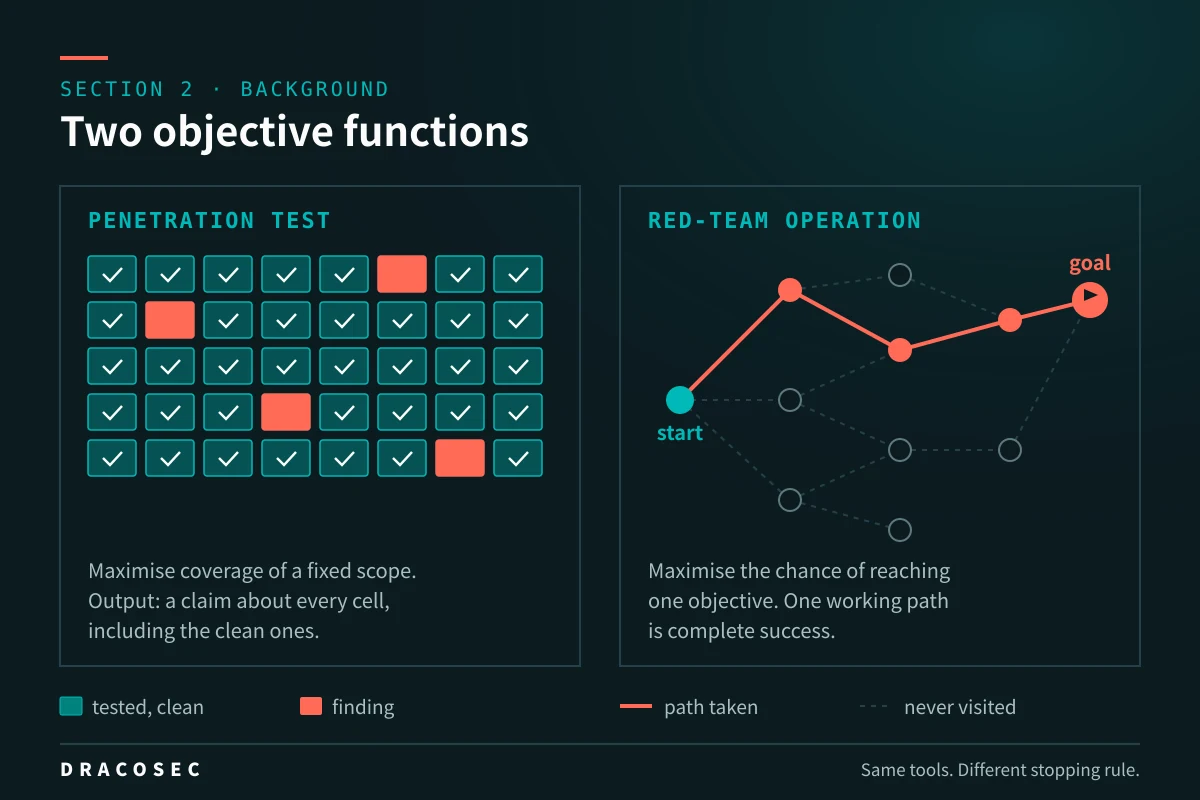
A penetration test maximises coverage within a fixed scope and time box, and its output is a claim about the entire scope, including areas in which nothing was found. A red-team operation, by contrast, maximises the probability of achieving a mission objective while evading detection. A single working path constitutes complete success, and enumerating further paths increases effort and detection risk without commensurate benefit.
In an agentic system, this distinction manifests in three places: what the prompt rewards, what the scheduler is permitted to enqueue, and what condition terminates the run.
3. Hypotheses
The central hypothesis is that mainstream AI-driven penetration testing tools, in which the model itself selects the next action, are goal-directed by design rather than coverage-driven. AI-assisted tools, in which a human operator selects each action, lie outside the scope of this hypothesis. Such a design is expected to produce run-to-run variability and to preclude any guarantee of a complete assessment.
Hypotheses and refutation criteria
| Label | Hypothesis | Refutation criterion: the code shows |
|---|---|---|
| Goal-directed design | The architecture implements the red-team objective (a single sufficient path to a goal) rather than the penetration testing objective (exhaustive coverage of a scope). | Work items generated by code from the scope inventory, or a run that cannot terminate until every scope item has been tested |
| No enforced coverage | No coverage state is enforced by the engine; consequently, the tested set depends on the model’s sampled trajectory and varies between runs. | A tested/untested ledger at endpoint or parameter granularity that gates termination in code, together with pinned sampling |
| Structural human role | Because the architecture has no internal coverage authority, coverage can be supplied only externally, by a human who navigates rather than merely approves. | An internal mechanism that enforces coverage without human input |
| Compliance limits (a to c) | Three structural limitations preclude compliance-grade delivery: (a) early observations decay under context management; (b) runs are auditable but not reproducible, and yield no negative assurance; (c) tool output reaches the model through a lossy translation layer (token limits or brittle parsing), shifting human effort toward validating findings. | (a) Observations retained verbatim regardless of run length; (b) pinned sampling and per-item tested-and-clean records in the report; (c) tool output parsed into structured state without silent loss |
4. Methodology
This study is a static, white-box analysis of each tool’s source code, as checked out on 2026-11-19. No tool was built or executed, and no target system was accessed. Static analysis establishes what an architecture permits and enforces; it cannot establish how frequently a behaviour occurs in practice. Accordingly, all claims concerning run-to-run variance are inferred from design rather than empirically measured.
Sampling
The analysed sample comprises two tools drawn from a purposive sample of six widely used, publicly available AI-driven penetration testing framework repositories. The target population is open-source AI-driven frameworks, defined as those in which a large language model (LLM) autonomously selects and executes security tools against a target with limited human input.
The two analysed AI-driven tools are characterised below.
| Tool | Language and runtime | Orchestration | Structured state beyond chat history | Action-selection authority |
|---|---|---|---|---|
| Tool A | Go host with an isolated Node agent worker | Single ReAct agent; optional orchestrator, plan-execute and supervisor modes, all LLM-led | Project fact blackboard with typed edges; vulnerability database; asset inventory with scan timestamps; LLM-authored to-do board | The model, on every turn; the Go host merely dispatches the tool the model names |
| Tool B | Go, built on an in-house agent SDK | Planner, workers and a main agent operating around a priority frontier, activated by graph events or a 600 s heartbeat | Global asset graph; per-task exploration graph (goal, intent, fact, finding and digest nodes); task scope table; coverage metric | The planner LLM, which is the sole writer of intents to the frontier |
Together, the two tools represent the two dominant designs in the population: a single ReAct agent with LLM-led delegation, and an event-driven planner/worker system operating over persistent graphs. Because Tool B advertises asset and exploration graphs, it is the strongest candidate in the sample for refuting the goal-directed design and no-enforced-coverage hypotheses.
Generalisation is by architecture type rather than by statistical inference. Given n = 2 and a popularity-based sampling frame, the findings characterise these AI-driven designs and should not be extended to the category as a whole, nor to AI-assisted tools, whose human-led control loop was not analysed.
Protocol
Each tool was analysed independently against the same ten dimensions: control loop and agent roles; prompt framing of objectives and stopping conditions; search and planning strategy; global state and coverage tracking; termination and early exit; memory and context management; tool-output handling; determinism and audit logging; human-in-the-loop (HITL) hooks; and verification and false-positive controls. Analysts were instructed to seek disconfirming evidence with the same rigour as confirming evidence, including coverage ledgers, checklists, deterministic pipelines, coverage metrics and retest loops.
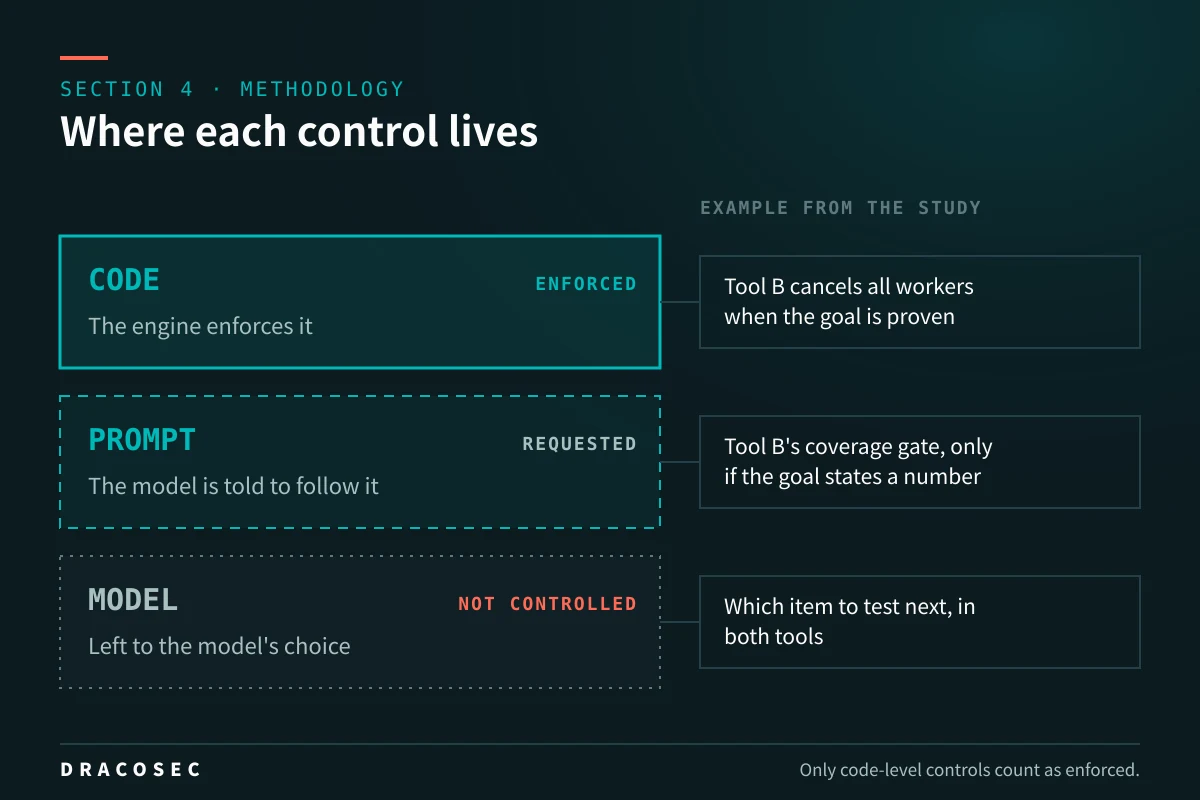
Central to this protocol is the locus of each control. Each control is classified as code (enforced by the engine), prompt (the model is instructed to comply) or model (left to the model’s discretion). Only code-level controls are treated as enforced; a prompt instruction is a request made to a stochastic system and offers no guarantee.
Evidence standard and anonymisation
Every key claim is tied to a file path, a line range and a short verbatim excerpt, and is marked as either read directly from the code or inferred from code structure. Each citation was re-verified against the source before inclusion. This verification revealed one omission: the initial analysis had overlooked a line in Tool A’s prompt that subordinates bounty value to the user’s completion conditions. That line is reported in Section 5.1.
For anonymisation, tools are labelled Tool A and Tool B. Product names in quoted prompts and identifiers are replaced with [TOOL]. File paths are given relative to each repository root, and product-named files or directories are renamed. Prompts written in Chinese are translated, with short original fragments retained where the precise wording is material. Line numbers refer to the analysed snapshot and will drift as the projects evolve.
Evaluation metrics
Ten metrics operationalise the research questions as questions about code. The first five, from work-item source to sibling handling, determine whether an engine can credibly claim coverage (RQ1, RQ2), and the remaining five, from sampling control to HITL mode, determine whether its output can support a compliance claim (RQ3, RQ4). An engine is classified as coverage-grade only if it satisfies the stated requirement on the first four (work-item source, coverage granularity, coverage enforcement and termination trigger).
| Metric | Question asked of the code | Coverage-grade requirement |
|---|---|---|
| Work-item source | What is the origin of test tasks? | Generated by code from the scope inventory, one per item; the model may reorder items but not drop them |
| Coverage granularity | Which unit does the coverage state track? | Endpoint × parameter × applicable test class |
| Coverage enforcement | Where does the coverage rule reside? | In code: the engine refuses to finish while any item remains untested and unexcluded |
| Termination trigger | What terminates a run? | Coverage completion; budget exhaustion is reported as an incomplete test |
| Sibling handling on success | What happens to in-flight and queued work when a goal is met? | Work continues; success does not terminate testing |
| Sampling control | Are temperature and seed pinned on the main loop? | Pinned and recorded for each run |
| Context retention | What survives verbatim over a long run? | Negative and positive observations stored outside the context window and never summarised away |
| Output fidelity | How does raw tool output reach the model? | Parsed into structured state alongside the raw evidence, with every truncation made explicit |
| Negative assurance | Does the deliverable record what was tested and found clean? | A tested-and-clean record for each item, with evidence references |
| HITL mode | Do human hooks merely block actions, or can they steer coverage? | Steering hooks, plus a human coverage checkpoint before completion |
Coverage granularity and coverage enforcement are measured on ordinal scales. Granularity ranges from none, through host or service, asset (including endpoint) and parameter, to parameter × test class. Enforcement ranges from none, through recorded (stored but not exposed to the model), advisory (exposed to the model) and prompt-gated (the model is instructed not to finish below a threshold), to code-gated.
5. Results
Each engine is built around the goal alone: Tool B enforces it in code, while Tool A's prompt instructs the model to stop there. Coverage is computed, displayed and, in some cases, written into prompts, yet no code path depends on it.
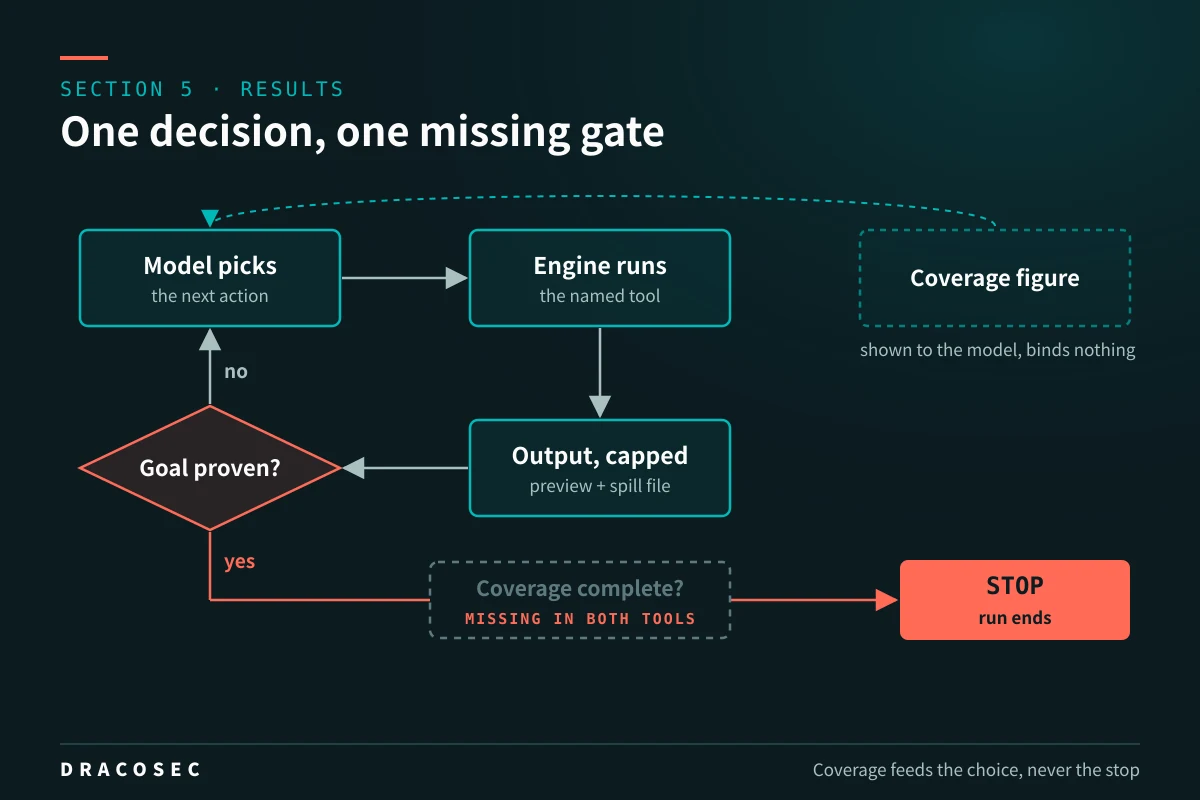
Each run iterates until the goal is proven. Coverage informs the model’s choices but is never interposed between “goal proven” and “stop”.
5.1 The goal is the objective function
Tool A’s default system prompt establishes an impact-maximising value function: the agent is instructed to reason as a bounty hunter, to regard “one critical vulnerability beats a hundred informational ones”, and to chain low-impact issues into high-impact paths (internal/agent/default_single_system_prompt.go:56-62). The same block stipulates that neither bounty value nor vulnerability counts may displace the user’s completion conditions, so the fixed point remains the user’s goal. The bundled operating skill states the underlying search model explicitly: penetration testing is “not running scripts, it is searching for a path” from a start state to a goal (skills/pentest-agent-os/SKILL.md:14-18).
Tool B’s planner has three responsibilities: assessing the situation, judging the goal, and adding an intent “only when there genuinely is an uncovered new direction” (agent/planner.go:300). It maintains two or three distinct routes and then concentrates effort on whichever first yields evidence “approaching the goal” (:333).
Termination is bound to the goal in each design. Tool A may finish only when the goal is reached with evidence, a hard boundary is encountered, or the user intervenes, and it must not continue invoking tools “to find more vulnerabilities” once the goal is met (default_single_system_prompt.go:33, :86-98). Tool B completes only when the planner proves the last open goal (agent/planner.go:316-317).
Because no code fixes the route, strategic pivoting emerges naturally. Tool A forces a change of strategy after three similar failures (default_single_system_prompt.go:98), and Tool B marks an intent that has exhausted its step budget as “exhausted”, allowing the planner to attempt another approach (server/engine.go:1253-1265). For an objective-based operation this is an appropriate design, and it accounts for both the effectiveness and the potential hazard of these tools in red-team use.
5.2 Work items come from the model, not the inventory
Tool B’s workers claim work solely from the frontier, a query for open intents ordered by priority (db/exploration.go:1136-1143). The only writers are the planner, the main agent, and a bootstrap function that seeds exactly one intent for the whole goal. No routine converts each discovered asset, endpoint or parameter into a work item, and duplicate intents are avoided by the model comparing free-text summaries rather than by a database key.
Tool A has no scheduler. Its Go dispatcher executes whichever tool the model names, following an allow-list check and HITL interception, and its to-do board is authored by the model. The outcome in each case is best-first search toward a goal: the most promising branch is expanded, and branches that appeared weak early on are not revisited. Tool A’s reconnaissance skill states this directly: map the surface, then “pick the fattest edge”.
5.3 Coverage is tracked, but advisory and coarse
Each tool computes coverage, yet the metric merely informs the model and constrains nothing.
Tool B documents its coverage type as “a reference figure for the agent, NOT a precise metric”. An asset counts as tested once it is anchored to at least one fact node (db/task_scope.go:276-286). Assets extend to endpoints, but parameters are not tracked as discrete items; they reside in a JSON field on the endpoint record (db/assets.go:54). The coverage field is deliberately withheld from the worker’s view so that workers execute only the claimed intent and “don’t chase uncovered points” (agent/worker.go:328-332).
Tool A computes scanned, never-scanned and stale counts, and a percentage, across its asset inventory (internal/database/asset.go:1273-1294). An asset is identified by host, IP address, port, domain and protocol, so the granularity is the service. The scan timestamp is updated only when the agent invokes the scan-completion tool. The model may filter for never-scanned assets, but nothing obliges it to do so.
The counter-evidence
Tool B’s planner prompt contains a genuine coverage gate. When the goal states a quantified condition such as “coverage reaches X%”, the planner must check coverage.pct and is prohibited from proving the goal below the target (agent/planner.go:318). It is also instructed to continue dispatching while the goal is unmet and untested surface remains in scope (:306). Tool A’s prompt prescribes breadth-first discovery before deep testing (default_single_system_prompt.go:37) and full-depth testing when the user requests a comprehensive assessment (:34).
Three limitations qualify this gate. First, it is a prompt instruction rather than code. Second, it is triggered only if a human writes a numeric target into the goal. Third, it is subordinate to a rule that ranks “depth over coverage” and describes coverage as “a floor / acceptance item, not the exploration goal itself” (agent/planner.go:332). Coverage must therefore be requested explicitly in natural language; it is not a property of either engine.
5.4 Success abandons sibling branches
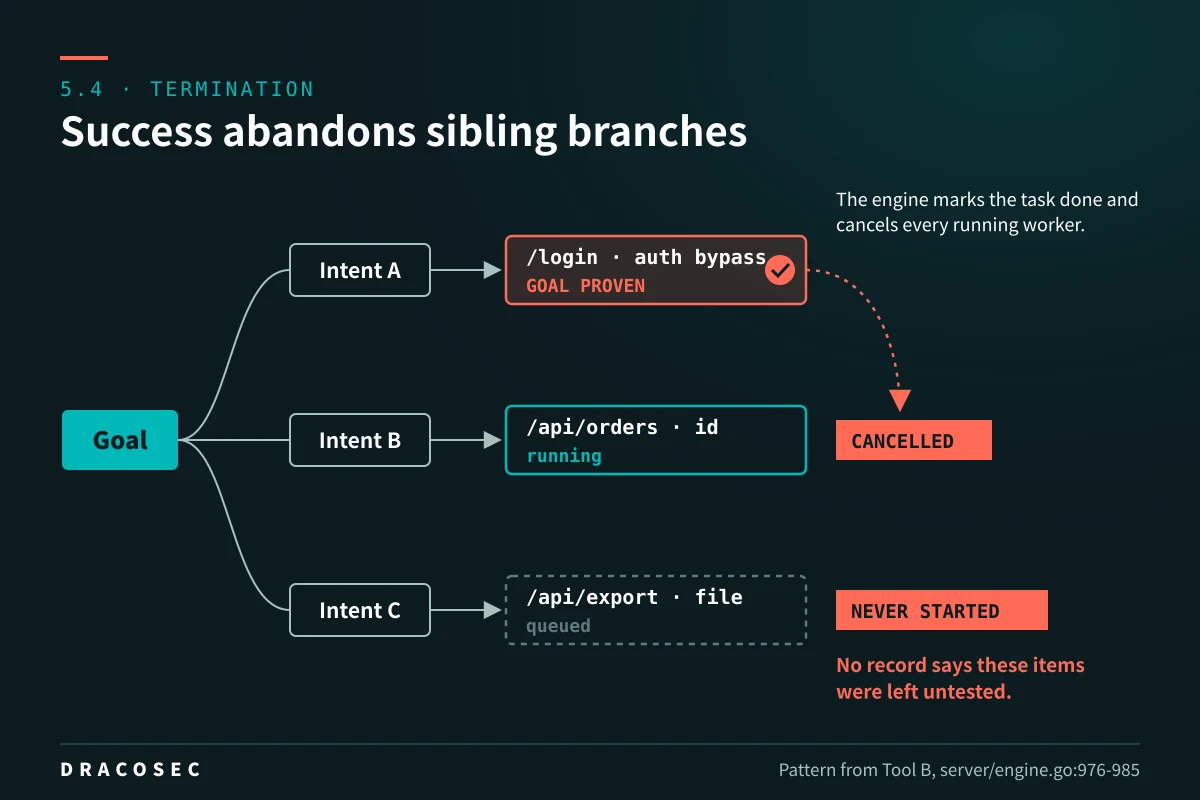
When Tool B proves its last goal, the engine sets the task to done and cancels every running worker, because “their intents’ results are meaningless now” (server/engine.go:976-985). Any intent in flight, potentially on another endpoint or parameter at the same depth, terminates without a record that it was left untested. Tool A’s prompt yields the same effect: once the goal is reached, the agent ceases to call tools.
5.5 Unpinned sampling makes the tested set vary between runs
Sampling parameters are not fixed in either main loop. A search of Tool B’s agent package finds no temperature, top-p or seed setting. Tool A’s agent worker likewise sets none; temperature appears only on auxiliary calls, such as the post-hoc attack-chain builder, which uses 0.3.
Variance then compounds. A different first tool output leads to a different first intent, a different frontier, and a different point at which the goal is proven and sibling work is cancelled. Without an enforced ledger anchoring the union of tested items, two runs against the same scope may test different subsets, and neither can identify which subset it omitted. As noted in Section 4, this variance is inferred from design rather than measured.
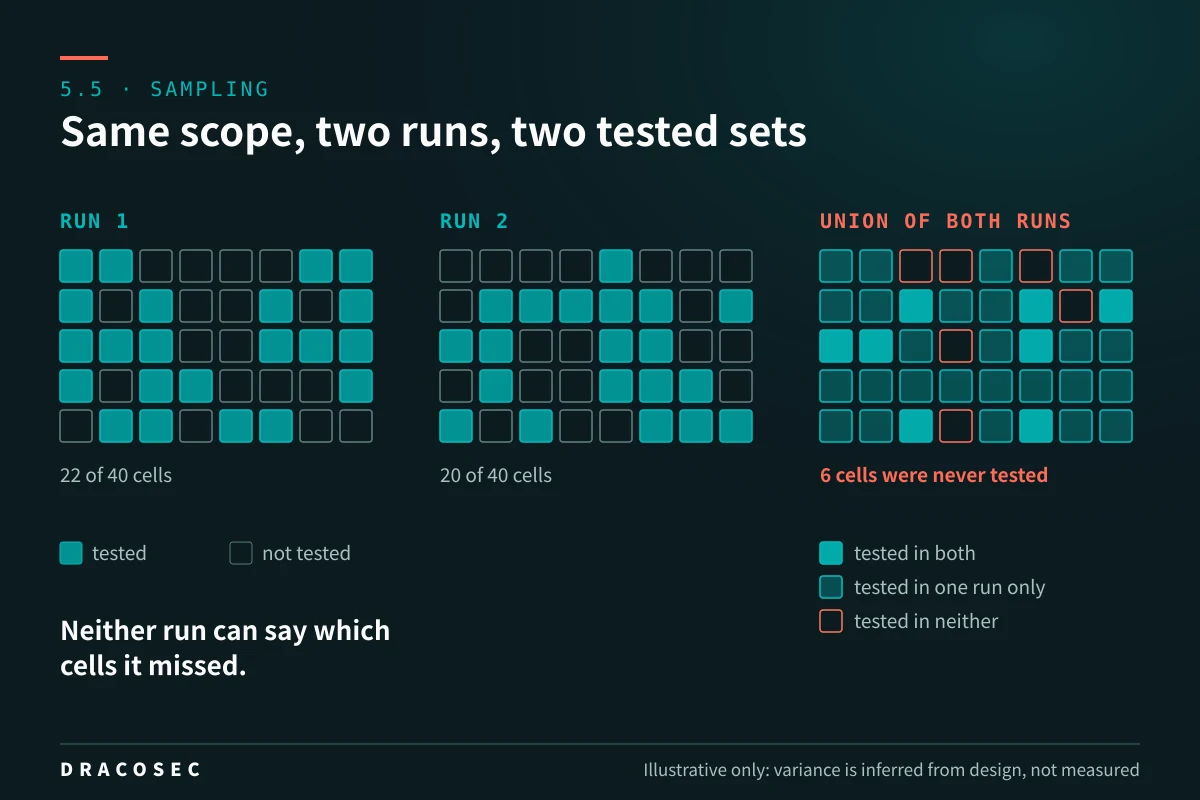
5.6 Context management compresses observations and keeps findings
Tool A relies on its agent SDK’s compaction mechanism, with a default input budget of 120,000 tokens. Only the most recent min(20,000, budget / 2) tokens are retained verbatim (runtime/pi/src/worker.ts:283). Compaction summaries are stored as project facts labelled “model-generated, not independently verified”. An early reconnaissance result therefore persists verbatim only if the model recorded it on the fact blackboard or subsequently re-reads the spilled output file.
Tool B adds graph-native eviction. Exploration nodes that remain inactive for at least six planner rounds, in blocks of at least two, are folded by an LLM call into a digest capped at 1,500 output tokens (agent/coldgraph.go:41-42). Only facts and settled intents are eligible for folding; findings and goals are never folded (agent/coldgraph.go:95-97). Confirmed results thus remain intact, whereas the record of what was observed and ruled out is compressed. For penetration testing this is the wrong half to lose, because negative observations constitute the foundation of any coverage claim.
5.7 Audit logs exist, but runs cannot be reproduced and reports carry no negative assurance
Logging is extensive in each tool. Tool A persists every tool call, capped tool result and reasoning step per turn, together with session files for resumption. Tool B retains a transcript for each planner and worker session, streams every step as an event, records target traffic through its proxy, and binds findings to traffic identifiers; its full LLM request and response recording is disabled by default.
A log of a single trajectory does not constitute a repeatable test procedure. With sampling unpinned (Section 5.5), a second run is a new experiment rather than a replay. Tool B’s report renderer lists confirmed findings and, where there are none, emits a single line: “no vulnerabilities confirmed in this run” (report/report.go:75). It does not record what was tested and found clean, which is the per-item evidence that PCI DSS segmentation testing calls for and that ISO/IEC 27001 auditors look for.
5.8 The model is the parser, through a bounded channel
Scanner output is not parsed by regular expressions or a structured parser in either tool; the model reads raw text, and what it receives is bounded. Tool A caps a tool result at 12,000 bytes by default and spills the remainder to disk, with a preview of at most 4,000 bytes in context (internal/mcp/tool_result_guard.go:5, internal/tooloutput/spill.go:153). Tool B applies its SDK’s 30,000-character cap, retaining the head together with a pointer to the spilled file (agent/worker.go:470-472), and truncates worker output shown to the planner at 800 characters.
No data is lost outright, because the raw output persists on disk. However, a weak signal, such as a marginally longer response time, a small change in response length, or a single anomalous line deep within a scan, is observed only if it falls within the preview or the model actively searches for it. Anything a tool does not print never reaches the model, including elapsed time unless the command reports it.
False positives are addressed through strict rules in each tool. Tool A requires attached evidence for any finding marked confirmed and prohibits “suspected” findings. Tool B requires that the issue was triggered during the run and employs a retester agent that returns reproduced, fixed or inconclusive. These rules reduce the false-positive rate, but they shift the human’s effort from navigation to adjudication, that is, verifying that the evidence attached by the model actually demonstrates what the model claims.
5.9 HITL hooks are brakes by default, with steering available
Tool A offers three modes: off, approval, and review-and-edit. A pre-execution interceptor can reject a tool call or rewrite its arguments, an LLM audit agent can substitute for the human, and steering messages are accepted between tool batches. Tool B’s intercept rules allow, deny or prompt per tool call; where no rule matches, the default is to allow, and its LLM-judge fallback is disabled by default.
These controls prevent harmful actions, but none asks what has not been tested. The hooks relevant to coverage are the steering hooks. Tool B’s main agent can add a hint for the planner, inject a high-priority intent, steer or terminate a running worker, and edit goals mid-run, while Tool A supports interrupt-and-continue with a human note. With these hooks a human can impose coverage, but no design obliges anyone to do so.
Scorecard
On none of the first four metrics (work-item source, coverage granularity, coverage enforcement and termination trigger) does either tool satisfy the coverage-grade requirement, so neither is coverage-grade as defined in Section 4. Tool B comes closest on coverage granularity and coverage enforcement.
| Metric | Tool A | Tool B | Meets requirement |
|---|---|---|---|
| Work-item source | Selected by the model on each turn | Planner-authored intents plus a single bootstrap intent | Not met |
| Coverage granularity | Host or service | Asset, including endpoint; parameters not tracked | Not met |
| Coverage enforcement | Advisory: the model can filter for never-scanned assets | Prompt-gated, and only when the goal states a numeric target | Not met |
| Termination trigger | Goal reached with evidence, hard boundary, or user stop; iteration cap of 12,000 in the example configuration and 3,000 as the code default | Last goal proven, empty frontier, or optional deadline; 1,200 s per worker run | Not met |
| Sibling handling | Prompt-level: the agent stops calling tools once the goal is met | The engine cancels all running workers | Not met |
| Sampling control | No temperature or seed pinned on the main loop | No temperature, top-p or seed pinned | Not met |
| Context retention | Most recent min(20k, budget / 2) tokens retained verbatim; 120k default budget | Facts and settled intents folded after 6 idle rounds; findings retained | Not met |
| Output fidelity | Raw text, 12,000 bytes; spill to disk plus a preview of up to 4,000 bytes | Raw text, 30,000 characters; spill to disk plus head; 800-character planner preview | Partly: raw evidence retained on disk, but no structured parse |
| Negative assurance | Asset-level scan timestamps only; no per-endpoint or per-parameter test record found | Report enumerates confirmed findings only | Not met |
| HITL mode | Approval or edit prior to execution; interrupt-and-continue | Permissive by default (allow); steering, intent injection and live goal edits available | Partly: steering is available, but there is no coverage checkpoint |
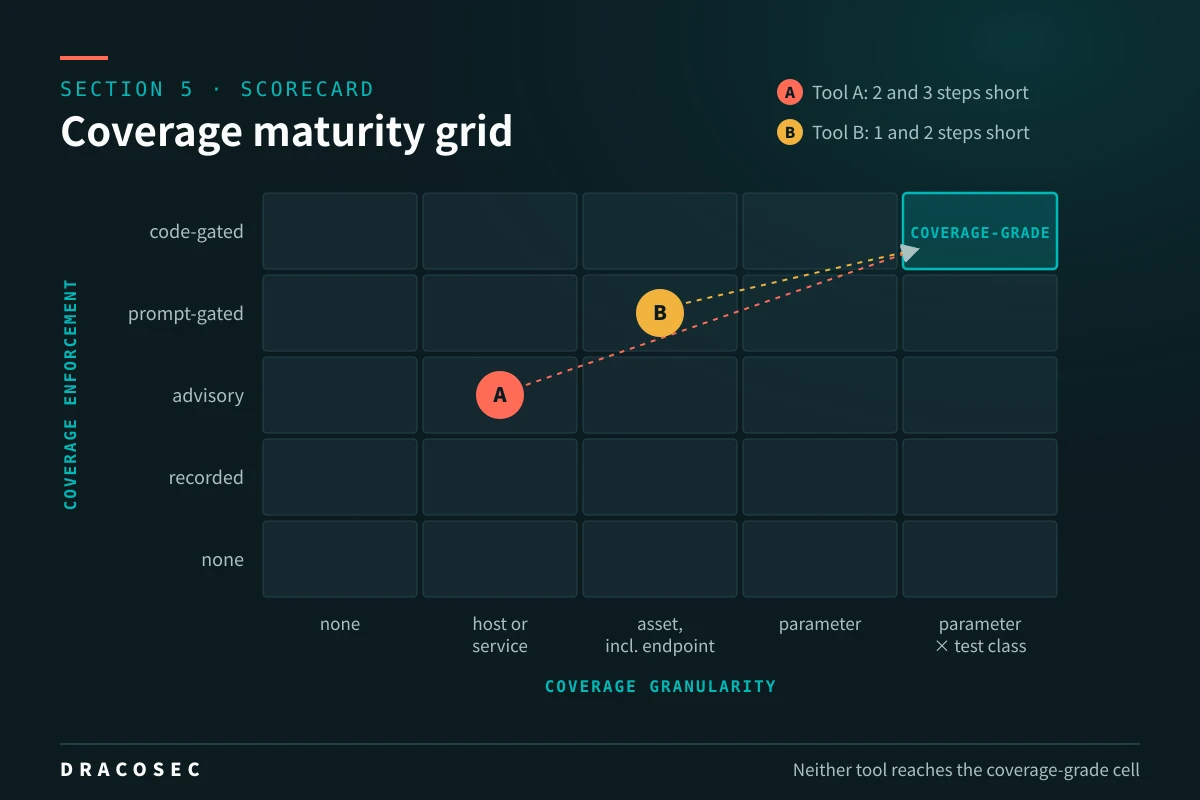
Tool B is one step short of coverage-grade on enforcement and two on granularity; Tool A is two steps short on enforcement and three on granularity.
6. Discussion
Hypothesis verdicts
| Hypothesis | Verdict | Deciding evidence |
|---|---|---|
| Goal-directed design | Supported | Work items selected by the model (Section 5.2); termination on goal or budget (Section 5.1); in-flight work cancelled on success (Section 5.4) |
| No enforced coverage | Supported, subject to a correction | Each tool computes coverage, but it is advisory or prompt-gated, and coarse-grained (Section 5.3); sampling is unpinned (Section 5.5). Variance is inferred, not measured |
| Structural human role | Supported | No internal coverage authority; steering hooks allow a human to supply one (Section 5.9) |
| Context decay | Supported | Verbatim window of min(20k, budget / 2) tokens; facts folded after 6 idle rounds while findings are retained (Section 5.6) |
| Not reproducible, no negative assurance | Supported | Unpinned sampling; findings-only report (Section 5.7) |
| Translation loss | Partly supported | Size caps and summarisation confirmed; no regex parsing found, since the model reads raw text; false-positive controls exist but shift human effort toward adjudication (Section 5.8) |
The correction to the no-enforced-coverage hypothesis sharpens the argument rather than weakening it. These tools know their coverage and nonetheless stop when the goal is met. The deficiency is therefore not missing data but missing enforcement, a design choice that can be reversed.
Recommendations
Until coverage is enforced in code, the human operator must act as the coverage engine. Each recommendation below addresses a specific gap identified in the scorecard.
For engagement leads: navigate, don’t just approve
- Maintain the ledger outside the model. Keep the scope matrix (asset × endpoint × parameter × test class) in the engagement plan rather than in the agent’s context, and treat the agent’s coverage figure as a heuristic, as Tool B’s code itself describes it (work-item source, coverage granularity).
- Treat every “goal met” as a checkpoint. Before accepting it, reconcile the ledger against what the run actually exercised, and inject work for the untested cells (termination trigger, sibling handling).
- State coverage in the goal as a number or an explicit completeness rule. In Tool B, this activates the planner’s prompt gate (coverage enforcement).
- Challenge premature convergence. When all open work concentrates on one route, ask which branch at the same depth was dropped, and why.
- Separate navigation from adjudication. Assign finding verification and coverage steering to different personnel, or schedule them as distinct passes, so that false-positive review does not displace coverage (output fidelity, HITL mode).
- Record exclusions explicitly, documenting what was not tested and why, so that the report can carry negative assurance.
For tool builders: move the coverage rule from the prompt into the engine
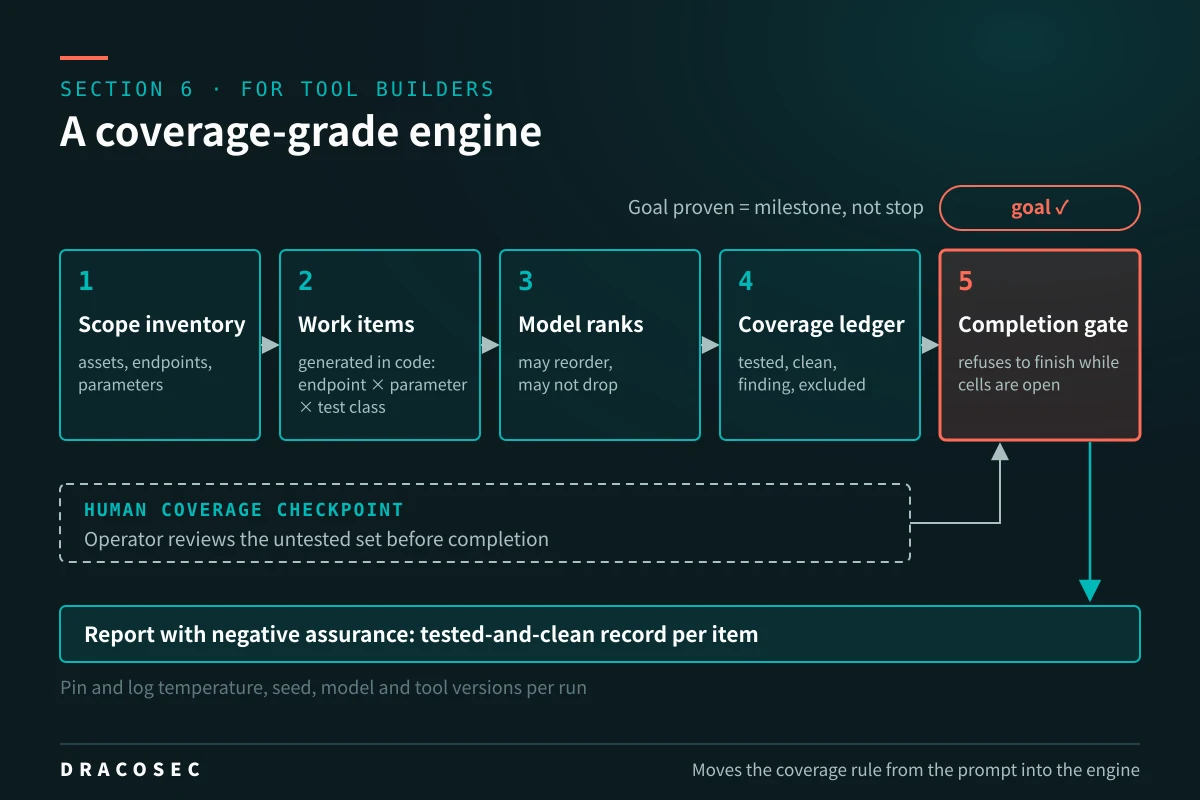
- Generate work items in code, one per in-scope endpoint × parameter × applicable test class; permit the model to prioritise them but not to drop them (work-item source, coverage granularity).
- Gate completion in code. Treat “goal proven” as a milestone, and permit a run to be marked complete only when every ledger cell is tested or explicitly excluded (coverage enforcement to sibling handling).
- Never fold negative observations; persist them as ledger entries outside the context window (context retention).
- Pin and log temperature, seed, model version and tool versions for each run, and provide a replay harness (sampling control).
- Emit a negative-assurance section containing per-item tested-and-clean records with evidence references (negative assurance).
- Parse scanner output into structured state alongside the raw text, and make every truncation explicit by stating what was omitted and where the full output is stored (output fidelity).
- Introduce a human coverage checkpoint that presents the untested set to the operator before completion (HITL mode).
For buyers and assessors
- Put the four coverage-grade questions (work-item source, coverage granularity, coverage enforcement and termination trigger) directly to vendors, and request evidence of where each answer is implemented in code.
- Require per-item test records, and not only findings, in any report intended for a compliance audit.
- Execute the same scope twice and compare the tested sets before accepting a tool’s coverage claim.
7. Limitations and Future Work
Limitations
The sample comprises two of six widely used AI-driven frameworks, selected by popularity; the findings therefore characterise these two designs and not the whole category. AI-assisted tools, in which a human selects each action, are outside the scope of this study. The analysis is static: it establishes what each architecture permits and enforces, not observed behaviour, and run-to-run variance is inferred from unpinned sampling and model-selected work items. Line citations refer to a single snapshot.
Future work
- Apply the same protocol to the four sampled tools not analysed in this study.
- Measure variance empirically by executing each tool repeatedly against a benchmark application with a known vulnerability inventory, reporting the overlap of tested sets and the recall per vulnerability class.
- Implement a code-level coverage gate in one tool and measure its effect on recall, run time and token cost.
8. Conclusion
For the two tools analysed, the hypothesis holds in its architectural form. They are goal-directed search engines that compute coverage without enforcing it; consequently, a single run cannot guarantee a complete assessment, and two runs need not agree.
In red-team use, these tools are efficient precisely because they are narrow. In penetration testing, they become coverage instruments only when a human maintains the ledger and the engine is made to respect it.
Working with DracoSec
DracoSec provides penetration testing, red team exercises and AI security assessments for organisations across Hong Kong. If your team is evaluating an AI pentest tool, or wants an engagement where coverage is tracked cell by cell and reported with negative assurance, we're happy to talk it through.
Contact us via web form or email: enquiry@dracosec.tech