
Oracle's July 2026 Critical Patch Update ran to 1,449 patches. Most Hong Kong security teams will have skimmed the headline numbers, noted that nothing in it was on fire locally, and moved on. That is a reasonable triage decision. But one entry in that release is specifically a Hong Kong problem, and it is worth ten minutes of your attention: CVE-2026-61252, an access control flaw in the Hong Kong Payroll component of Oracle HRMS.
It scores 5.4. It is not a crisis. It is also not the sort of thing you want to discover during an audit, in a module that produces your IR56 returns.
Here is what the evidence supports, and, just as importantly, where the evidence runs out.
What Oracle actually published
Oracle's CVE record is short, and worth reading closely rather than through a scanner summary. It describes a vulnerability in the Oracle HRMS (Hong Kong) product of Oracle E-Business Suite, in the component named Hong Kong Payroll. Supported versions affected are 12.2.13 through 12.2.15.
Oracle calls it easily exploitable, and says it allows a low privileged attacker with network access via HTTP to compromise Oracle HRMS (Hong Kong). A successful attack can result in unauthorised update, insert, or delete access to some Oracle HRMS (Hong Kong) accessible data, and unauthorised read access to a subset of that data.
The assigned score is CVSS 3.1 base 5.4, vector CVSS:3.1/AV:N/AC:L/PR:L/UI:N/S:U/C:L/I:L/A:N, with confidentiality and integrity impacts and no availability impact.
CISA's Vulnrichment programme enriched the record on 22 July 2026, adding CWE-284, Improper Access Control, and an SSVC assessment of Exploitation none, Automatable no, Technical Impact partial.
That is the entirety of the public record. Oracle's disclosure policy states plainly that it does not release detailed security analysis to customers, so there is no advisory text beyond the risk matrix entry.
Reading the vector
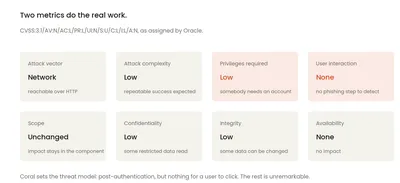
The score is the least interesting part of the vector. Two metrics do the real work.
PR:L tells you this is a post-authentication issue. Somebody needs an account. That immediately changes the threat model from "internet-facing emergency" to "what can a person who is already inside do". Oracle does not say which responsibility or privilege level qualifies, so we cannot tell you how many of your users meet the bar. Anyone who claims otherwise is guessing.
UI:N tells you nobody has to click anything. There is no phishing step to detect and no user to train. Under the CVSS specification, that value means the vulnerable system can be exploited without interaction from any user.
Everything else is unremarkable: network reachable over HTTP, low complexity, unchanged scope, partial rather than total impact on confidentiality and integrity.
| Metric | Oracle's value | What the CVSS 3.1 spec means by it |
|---|---|---|
| Attack Vector | Network | Bound to the network stack, remotely exploitable |
| Attack Complexity | Low | No specialised conditions, repeatable success expected |
| Privileges Required | Low | Privileges providing basic user capabilities. Authentication required |
| User Interaction | None | Exploitable without interaction from any user |
| Scope | Unchanged | Vulnerable and impacted component are the same |
| Confidentiality | Low | Some restricted information obtained, attacker cannot choose what |
| Integrity | Low | Data modification possible, attacker cannot control the consequence |
| Availability | None | No availability impact |
It is not a one-off
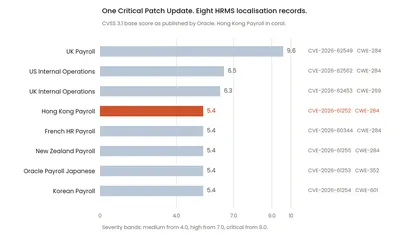
The more useful finding came from stepping back. We pulled the published CVE records for the other HRMS localisation entries in the same Critical Patch Update and put them side by side.
| CVE | Localisation | Component | Affected | CVSS | Vector | CWE |
|---|---|---|---|---|---|---|
| CVE-2026-62549 | UK | UK Payroll | 12.2.3-12.2.15 | 9.6 | AV:N/AC:L/PR:L/UI:N/S:C/C:H/I:H/A:N | CWE-284 |
| CVE-2026-62562 | US | Internal Operations | 12.2.3-12.2.15 | 6.5 | AV:N/AC:L/PR:L/UI:N/S:U/C:H/I:N/A:N | CWE-284 |
| CVE-2026-62453 | UK | Internal Operations | 12.2.3-12.2.15 | 6.3 | AV:N/AC:L/PR:L/UI:N/S:U/C:L/I:L/A:L | CWE-269 |
| CVE-2026-61252 | Hong Kong | Hong Kong Payroll | 12.2.13-12.2.15 | 5.4 | AV:N/AC:L/PR:L/UI:N/S:U/C:L/I:L/A:N | CWE-284 |
| CVE-2026-60344 | France | French HR Payroll | 12.2.3-12.2.15 | 5.4 | AV:N/AC:L/PR:L/UI:N/S:U/C:L/I:L/A:N | CWE-284 |
| CVE-2026-61255 | New Zealand | New Zealand Payroll | 12.2.3-12.2.15 | 5.4 | AV:N/AC:L/PR:L/UI:N/S:U/C:L/I:L/A:N | CWE-284 |
| CVE-2026-61253 | Japan | Oracle Payroll Japanese | 12.2.3-12.2.15 | 5.4 | AV:N/AC:L/PR:N/UI:R/S:U/C:L/I:L/A:N | CWE-352 |
| CVE-2026-61254 | Korea | Korean Payroll | 12.2.3-12.2.15 | 5.4 | AV:N/AC:L/PR:N/UI:R/S:U/C:L/I:L/A:N | CWE-601 |
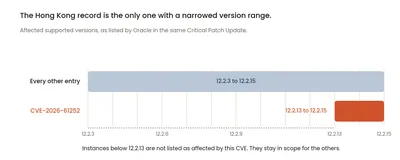
Four things stand out, and we are deliberately reporting them as readings of the table rather than conclusions about the code.
Hong Kong, France, and New Zealand are identical on paper. Same score, same vector, same CWE, same kind of component. Whether they share a root cause or a single fix is not something Oracle has published, and we are not going to assert it.
Hong Kong is the odd one out on versions. Every other entry in the group is listed as 12.2.3 through 12.2.15. This one starts at 12.2.13. Practically, that means Oracle does not list instances below 12.2.13 as affected by this CVE. It does not mean those instances are clear of the others, if you have those localisations installed.
The same weakness class turns up at 9.6. CVE-2026-62549 in UK Payroll is also CWE-284 with PR:L, but Oracle assigned it scope change and High impact on both confidentiality and integrity. If you are a Hong Kong subsidiary running UK Payroll on the same instance, that one outranks the local entry by a wide margin.
Japan and Korea are different animals. Both are PR:N with UI:R, classified as cross site request forgery and open redirect respectively. They belong in a separate bucket.
One more thing worth noting: Oracle's July 2026 credit statement names external researchers against specific CVE identifiers, and none of the eight identifiers above appear in it. We report that as an observation and leave it there.
What the module handles
CVSS says nothing about what the data is. In this case that matters more than the score.
Oracle's own R12.2 supplement documentation for Hong Kong HRMS lists what the localisation delivers. Reading down the contents: Mandatory Provident Fund scheme enrolment, MPF balance adjustments, voluntary lump sum employee deductions and employer liabilities, MPF remittance reporting including the eMPF remittance report. Inland Revenue reporting covering IR56B annual employer's return, IR56E, IR56F for employees ceasing employment but remaining in Hong Kong, and IR56G for those departing, plus the IR56B archive process. Minimum Wage Ordinance processing. Payroll balances, statement of earnings, pay advice, and payroll payment and distribution.
That is the statutory core of Hong Kong payroll. What Oracle does not tell us is which of those functions, or which underlying tables, sit inside the "some" and "subset of" data referenced in the CVE text. So the honest position is that the module in question is high value, and the extent of access within it is undefined.
What nobody knows, including us
We think this section belongs in every CVE write-up and rarely appears in any.
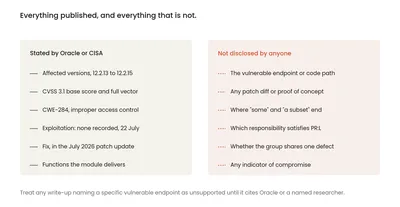
There is no published vulnerable endpoint, parameter, or code path. No patch diff. No proof of concept. No write-up from a named researcher. Oracle does not say which responsibility satisfies the privilege requirement, and it does not say whether the localisation entries share a fix.
We have not tested this vulnerability and we are not publishing a theory about its root cause. If you come across a vendor blog that names the specific vulnerable page or parameter for CVE-2026-61252, check whether it cites Oracle or names a researcher with reproducible work. If it does neither, it is filling a gap with imagination.
Is anyone exploiting it
CISA recorded Exploitation as none at enrichment on 22 July 2026. We are aware of no public exploit code and no public report of exploitation.
That said, the surrounding picture in this patch cycle is not quiet. CVE-2026-46817 in Oracle E-Business Suite has been confirmed exploited and sits in CISA's Known Exploited Vulnerabilities catalogue. PeopleSoft flaws CVE-2026-35273 and CVE-2026-35278 have been publicly reported as under active exploitation by ShinyHunters. Neither involves CVE-2026-61252, but both are relevant to how you sequence an Oracle estate.
Why this lands differently in Hong Kong
Two regimes shape what an unpatched payroll flaw costs you here, and they have both moved recently.
On the privacy side, DPP4 of the PDPO governs security of personal data. Breach notification to the Privacy Commissioner remains voluntary rather than statutory, but a breach can itself amount to a DPP4 contravention leading to investigation and an enforcement notice. As of February 2026 the PCPD has revived its reform agenda and is consulting lawmakers on amendments that would make notification to both the Commissioner and affected individuals mandatory. The 2025 numbers show why: 4,228 complaints, up 23 percent, and 246 voluntary breach notifications, up 21 percent, of which 81 were hacking related, up 33 percent.
On the cybersecurity side, the Protection of Critical Infrastructures (Computer Systems) Ordinance, Cap. 653, has been in force since 1 January 2026, with the Commissioner's Code of Practice issued the same day. Designated operators carry three categories of obligation covering organisational measures, preventive measures, and incident reporting and response. Preventive obligations include regular risk assessments and security audits, which is where an unpatched known vulnerability stops being purely a security matter. Penalties run to HK$5 million with daily fines for continuing offences. Two details are easy to miss: designated operators are expected to hold their suppliers to comparable standards, so this reaches further than the designation list suggests, and the Security Bureau has confirmed that notifying the Commissioner is a separate obligation from notifying the PCPD.
What we would do
Everything above is what the evidence says. This part is our advice.
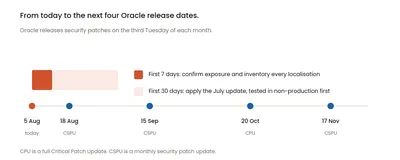
In the first week, work out whether you are actually affected. Is Oracle HRMS (Hong Kong) licensed and installed, and is the instance at 12.2.13, 12.2.14, or 12.2.15? While you are in there, list every other localisation on the same instance. If UK Payroll is present, CVE-2026-62549 is the one to fix first. Then establish which HR interfaces are reachable from outside your network, since the population able to authenticate is the population that matters for a PR:L issue.
In the first month, apply the July 2026 Critical Patch Update for E-Business Suite via the Patch Availability Document on My Oracle Support, testing in non-production first. Oracle notes that CPU patches are usually cumulative, so this also clears anything you deferred earlier. Alongside that, do the unglamorous account work: dormant self-service accounts, leavers who were never disabled, MFA at the perimeter, responsibilities that have quietly accumulated privileges.
If patching genuinely cannot happen yet, Oracle's own guidance is to consider blocking the network protocols an attack requires, and removing privileges or package access from users who do not need them. Oracle is equally clear that both can break application functionality, that changes should be tested off production, and that neither is a long term solution because neither fixes the underlying problem. Treat it as a bridge, not a destination.
For monitoring, there are no indicators of compromise for this CVE, so anything we suggest is generic EBS hygiene rather than a detection for this bug. Turn on and actually read the audit trail over core HR and payroll tables, PER_ALL_PEOPLE_F and the PAY_* element and bank detail tables among them. Correlate FND_LOGINS and FND_UNSUCCESSFUL_LOGINS against your Oracle HTTP Server and WebLogic access logs. Alert when an account with no payroll responsibility writes to payroll data. Baseline bank detail changes before each payroll run, and reconcile the payroll register against MPF and IR56 submissions every cycle. That last one is worth doing whether or not this CVE ever gets exploited.
Finally, write down the decision. Whether you patch this week or schedule it for next month, record the reasoning, the compensating controls, and who signed it off. Under Cap. 653, that record is the difference between a defensible position and an awkward conversation.
The larger point
Oracle's July advisory opens with a warning it repeats every quarter, and it is the most useful sentence in the document. Oracle says it continues to receive reports of attempted exploitation of vulnerabilities for which patches have already been released, and that in some cases attackers succeeded because the targeted customers had not applied available patches. It strongly recommends staying on supported versions and applying patches without delay.
CVE-2026-61252 is one medium severity line item in a release of 1,449 patches spanning 32 product families. On its own it does not justify an emergency change window. The release as a whole does, and Oracle now ships security patches on the third Tuesday of every month, with the next dates being 18 August 2026, 15 September 2026, 20 October 2026, and 17 November 2026. If your Oracle patching still runs on a quarterly rhythm, that is the thing worth changing this month.
Sources
- Oracle Critical Patch Update Advisory, July 2026: https://www.oracle.com/security-alerts/cpujul2026.html
- Oracle CPU July 2026 risk matrices, text form: https://www.oracle.com/security-alerts/cpujul2026verbose.html
- Published CVE records for CVE-2026-61252 and the HRMS localisation group, CNA Oracle, with CISA ADP enrichment
- Oracle Human Resources Management System Supplement (Hong Kong), Release 12.2: https://docs.oracle.com/cd/E26401_01/doc.122/f17362/toc.htm
- CISA Known Exploited Vulnerabilities catalogue
- FIRST, Common Vulnerability Scoring System v3.1 Specification Document
- Protection of Critical Infrastructures (Computer Systems) Ordinance (Cap. 653) and the Commissioner's Code of Practice
- Office of the Privacy Commissioner for Personal Data, statistics for 2025
Every factual claim in this post is drawn from the sources above. Where the public record is silent, we have said so rather than filled the gap.
About DracoSec Research Limited
DracoSec Research Limited is a Hong Kong based threat intelligence and offensive security firm. We work out which vulnerabilities are actually exploitable in a client's environment, and prove it rather than assert it.
We offer penetration testing across external and internal networks, web and mobile applications, and APIs, including ERP platforms such as Oracle E-Business Suite and SAP. We run security assessments and configuration reviews covering architecture, secure configuration benchmarking, and privilege and access control audits. We deliver red team and adversary simulation engagements modelled on the threat actors operating in this region. And we advise on vulnerability management, including patch prioritisation and exposure triage mapped to PDPO and Cap. 653 obligations.
If you run Oracle E-Business Suite in Hong Kong and want an independent read on your exposure, get in touch via web form or email: enquiry@dracosec.tech
返回上頁